piton
piton
VELAIR
[14]

VELAIR

2026
Client
VELAIR
Year
2026
Scope
3D web experience, scroll animation, WebGL
Role
Design / Development
§ Case Study

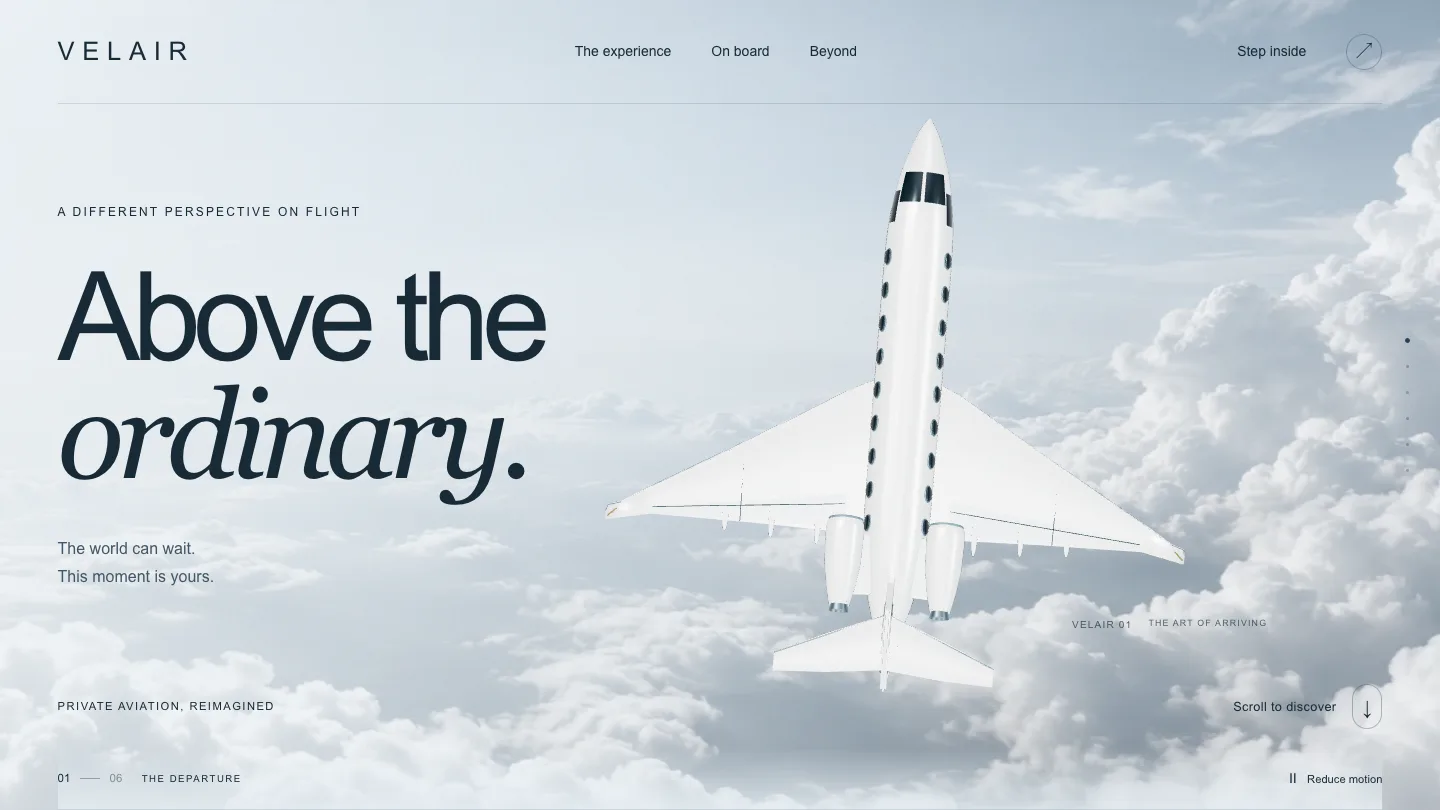
VELAIR — Scroll-driven cinematic 3D private-jet experience — cloud transition, opening cabin and fly-by.

VELAIR is a concept that turns the private-jet experience into a cinematic, scroll-driven 3D story. A top-down jet view, a shader-based cloud transition, an opening cabin and a side fly-by behind a panel all unfold in one natural scroll flow; the aircraft is an original parametric model generated in code.

Built with Next.js, React Three Fiber, Drei and GSAP ScrollTrigger, a single progress value drives the camera, the jet and the clouds, with no continuous rendering while idle. A reduced-motion option, static images rendered from the same model when WebGL is unavailable, and mobile-specific framing keep performance and accessibility in balance.

Three.jsReact Three FiberGSAPNext.js

Challenge

VELAIR is a concept Piton launched on its own initiative — there is no real client or aircraft manufacturer behind it. The goal was to build a private-jet-themed portfolio piece on original geometry generated in the browser, rather than purchased 3D models or video footage; to blend a top-down view, a cloud transition, a cabin reveal and a horizontal flight into one seamless, natural scroll flow; and to keep the experience readable on devices without WebGL support, under a reduced-motion preference, and on narrow mobile screens — all while holding performance steady with a single canvas and a single playhead.

Solution

In the Next.js App Router, content stays a server component while the Three.js scene lazy-loads only on the client. The aircraft is a parametric geometry built and assembled piece by piece in the browser — there is no downloaded 3D model file. A single GSAP ScrollTrigger produces one 0–1 progress value, which a pure function converts into camera, jet and cloud pose, while a separate helper adjusts zoom and mobile framing to viewport height. The scene renders on demand: frames are drawn only when the user scrolls, with no per-frame React state or DOM measurement. When WebGL2 isn't supported, on context loss, or under a reduced-motion preference, the experience falls back to static posters rendered from the same model; cabin-selection buttons are accessible to screen readers. Section boundaries, pose sampling and mobile framing are covered by automated tests run with the Node test runner.

Key technical decisions

  • The aircraft isn't an imported GLB — it's an original geometry built and assembled parametrically in the browser.
  • A single GSAP ScrollTrigger progress value drives the camera, the jet and the cloud shader together; no per-frame React state is used.
  • On-demand rendering: the scene redraws only on scroll, so no GPU work is spent while idle, with device pixel ratio capped to a 1–1.5 range.
  • A seamless fallback to static posters rendered from the same model when WebGL2 is unsupported, on context loss, or under a reduced-motion preference.
  • Automated tests for section boundaries, pose sampling and mobile framing run with the Node test runner.

Tech stack

Next.jsReactTypeScriptThree.jsReact Three FiberDreiGSAPVercel

Outcome

The result is a live concept demo that carries visitors through six sections in one uninterrupted scroll flow. Staying readable without WebGL, under reduced motion, and on mobile, it stands as a reference showcasing our 3D storytelling and motion-design capability. As we note in our own documentation, a licensed artist model and device-level performance benchmarking are subjects for the next production round.