ERP for Manufacturing Companies
A manufacturing ERP shows how much stock exists per product, what stage each order is at in production, and how much each dealer owes — all from one panel. We built exactly this for FurCRM, a furniture manufacturer: product/variant, accounts, quote-order-invoice flow, and dealer management unified in one system — the same architecture adapts to other manufacturing sectors.
Where manufacturers lose ground without an ERP
When stock is tracked in spreadsheets, the gap between actual and recorded stock causes orders to be planned wrong.
When dealer balances live in separate ledgers, figuring out who owes what becomes a manual exercise at month-end.
When quotes, orders, and invoices are separate documents, the same information gets entered by hand three times, compounding error risk.
How we work
In manufacturing, complexity mostly comes from product variety: dozens of variants of the same product, each with its own stock level, each order at its own production stage. Tracking this in spreadsheets works at a certain scale, but as product and dealer count grow, row count grows with it; which variant is out of stock or which dealer has an overdue balance gets noticed too late. A manufacturing ERP unifies this data in one schema: product/variant, order, production stage, and dealer account are linked — entering an order automatically updates stock, the production plan, and the dealer's balance, with nothing kept in sync by hand.
The concrete proof of this approach is FurCRM: for furniture manufacturers we unified product & variant management, customer CRM, accounts & finance tracking, the quote-order-invoice flow, and dealer management in one panel; a production tracking screen, reporting dashboard, and staff/commission modules cover the entire operation. Built as our own product, this is our most complete example of sector-specific SaaS productization. We adapt the same data model — product/variant, order, production stage, dealer account — beyond furniture to other manufacturing sectors; the core architecture stays the same while field names and business rules change to fit yours.
We start by mapping your product and variant structure, order process, and dealer network — the same process-audit and data-model-design steps we followed for FurCRM. Existing spreadsheet and accounting data migrates into the new system, and the team is trained before go-live. Scope depends on your product variety and dealer count; a smaller manufacturer might need only stock and order tracking, while a firm with a wide dealer network prioritizes the accounts/collections module sooner. The system is built on PostgreSQL so new modules can be added as you grow, whether that means a new dealer network or an additional production line.
What this solution includes
- Product- and variant-level stock tracking — how much of which model, in which color or size, is on one screen.
- Production tracking panel — which stage an order is at in production, the same module we built for FurCRM.
- Dealer management — dealer-specific pricing, order history, and account balance tracked from one place.
- Quote-order-invoice flow moves forward automatically — the same data is never entered by hand three times.
- Staff, commission, and performance modules report production efficiency from the same system.
Related projects
View all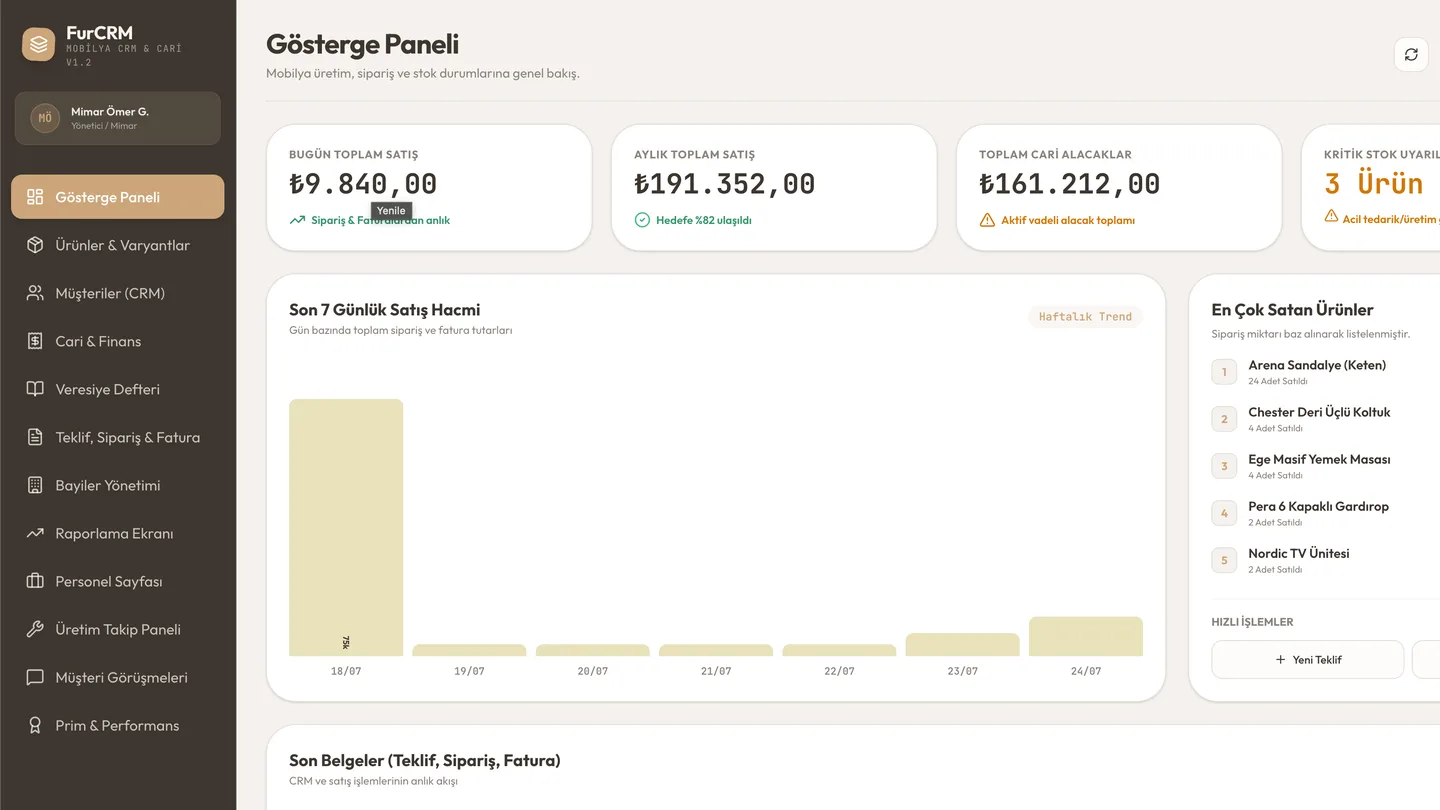
Service
Frequently asked
Industry and related solutions
Other solutions
Bring production and dealer tracking into one panel — let's talk about your manufacturing ERP.
Describe what you need; we’ll reply within 24 hours with a concrete roadmap.